Struggling with Fragmented Legacy Systems? Simplify Integration with Integration Platform as a Service (iPaaS)

1. Executive Summary
This article examines how applying Integration Platform as a Service (iPaaS) to legacy environments streamlines system integration, accelerates time to value, and fully leverages existing technology investments.
Against a backdrop of rising Information Technology (IT) costs, fragmented data landscapes, increasing integration complexity, and limited appetite or budget to replace legacy systems with greenfield technologies, organisations are turning to simplified approaches for system connectivity.
iPaaS solutions are emerging as a strategic lever to address these challenges. iPaaS is a cloud-based suite of services that enables the design, execution, and governance of integration flows connecting applications, data, and workflows across on-premises systems and cloud environments. This reduces the need for complex custom coding, point-to-point integrations, or complex middleware used in traditional integration approaches.
By providing a unified, scalable, and flexible approach to integration, iPaaS helps businesses streamline processes, reduce time-to-value, and extend the useful life of legacy systems while reducing operating costs.
In conclusion, iPaaS is a practical enabler to unlock process efficiencies, ensure return on existing IT investments, while creating a scalable technology core suitable for a digital-first world. Legacy systems still have a role to play, provided they are connected through the right integration architecture. Successful adoption of iPaaS requires a disciplined, use-case-driven implementation approach to ensure measurable value delivery.
2. Introduction and the Case for Change
Modern organisations, despite significant investments in digital transformation, frequently encounter a pervasive challenge: systems fragmentation. This issue creates unseen barriers to agility and value realisation, hindering the very objectives these transformations aim to achieve. This is a common challenge across industries and enterprise of differing sizes.
The operational impact of this fragmentation is especially pronounced in critical areas. For instance, Gartner’s 2025 Market Guide for Network Automation Platforms reveals that a significant 67% of enterprise network activity continues to be manual. This high degree of manual intervention is a direct consequence of what are termed “automation islands” – disconnected tools that cannot scale beyond isolated, functional tasks, thereby necessitating reliance on manual handoffs and custom workarounds for end-to-end processes. In such cases, automation has not failed: it is simply fragmented and siloed.
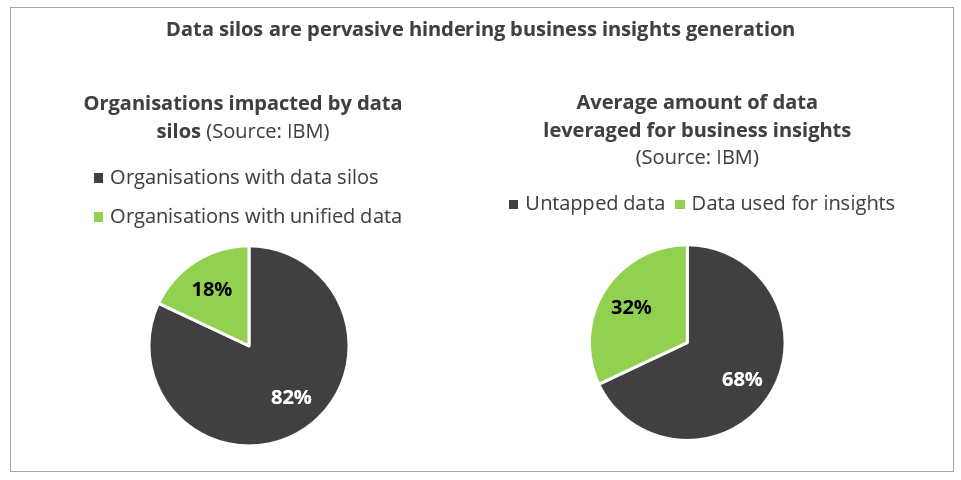
Siloed systems fragment the data environment, limiting the organisation’s ability to leverage data as a strategic asset. According to IBM, only 1 in 5 organisations have a unified data environment. As such, nearly 70% of data in organisations remains untapped for insights. The following visuals illustrate the scale of this challenge.
At a macro level, this fragmentation results in an inability to maximise return on investment (ROI) on IT investments and limits the capacity to leverage technology in support of business strategy. This, in turn, underscores the need to integrate systems more effectively and build a unified IT environment. For CTOs, CIOs, and IT leaders, the priority is clear: maximise existing IT investments. With limited capital and little appetite for full system replacements, integration has become the most practical path forward.
Adding to this imperative is the current wave of AI advancements and heightened board-level expectations for organisations to adopt AI in their operations. To effectively leverage AI, streamlined processes and clean integrated data are essential.
These are just some of the compelling drivers behind the modern organisation’s need for integrated system environments. Let us explore additional reasons why IT leaders are prioritising systems integration.
3. Business Impact of System Fragmentation
Following the explanations of the limitations that are brought about by system fragmentation described above, there are also commonly experienced limitations which further necessitate the need for integration:
- Data silos: By virtue of the system gaps, data sharing is limited which inhibits the ability of the organisation to holistically leverage its data assets for improved decision making.
- Process inefficiencies from manual workarounds: Inefficient manual work arounds become necessary to ensure processes can work to some extent. These workarounds often introduce process inefficiencies.
- Delayed processing and reporting: due to the data silos it becomes challenging and time-consuming to manually source and consolidate data from different sources.
- Poor visibility: Business units operate in isolation, making it hard to align resources, monitor performance, or respond quickly to issues.
- User frustration and low productivity: Fragmented tools create poor user experiences, resulting in low adoption, workaround usage, and growing support costs.
- Barriers to AI and innovation: Disconnected systems make it hard to pilot or scale data-enabled initiatives such as Artificial Intelligence (AI), Machine Learning (ML), and advanced analytics – delaying innovation.
Taken together, these issues create a “strategic drag” on the organisation. Fragmentation slows decision-making, increases costs, and blocks the adoption of high-impact technologies like AI. It limits agility, reduces return on existing IT investments, and ultimately constrains the organisation’s ability to compete, scale, and innovate in a digital-first economy.
4. iPaaS: A modern solution to systems integration
In the context of the above challenges and constraints, how can organisations establish a unified systems environment? iPaaS platforms are an increasingly viable modern solution for legacy system integration.
iPaaS is a cloud-based solution that enables organisations to seamlessly connect a wide range of applications, data sources, and business processes – whether they operate on-premises or in the cloud. It acts as the digital backbone of your IT environment, ensuring systems interact efficiently and cohesively.
iPaaS offers a standardised, secure, and scalable platform for designing, managing, and governing integration workflows. It includes essential capabilities such as prebuilt connectors, data transformation and mapping, workflow orchestration, and robust security features – with the ability to scale dynamically based on demand. The graphic below outlines how an iPaaS platform establishes connection to data in various systems and applications to create a unified data environment.
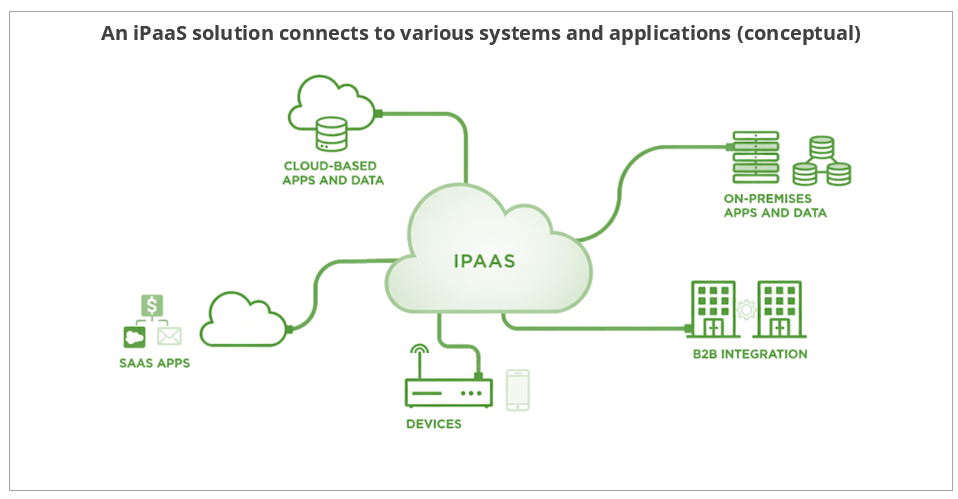
Supporting multiple integration patterns – including application-to-application (A2A), business-to-business (B2B), cloud-to-cloud, and hybrid setups – iPaaS simplifies the integration landscape. By abstracting the infrastructure layer, it allows IT teams to focus on delivering business value through integration, rather than managing complex middleware components. Some of the iPaaS solutions recognised as leaders by Gartner are Workato, Boomi, SAP Integration Suite, Informatica, MuleSoft, and Microsoft Azure Integration Services. Other mid-tier and more affordable platforms suited for small to medium enterprises include Flowgear and Quickwork.
Unlike traditional middleware or point-to-point integration, iPaaS is delivered as a cloud-based service, avoiding large upfront infrastructure investments and lengthy deployments. Its simplicity lies in rapid configuration, pre-built connectors, and scalability on demand. This flexibility enables organisations to adapt quickly to new business requirements, integrate both legacy and modern applications, and achieve faster time to value with significantly lower maintenance overhead.
4.1 Benefits of iPaaS
iPaaS delivers several benefits in comparison to traditional approaches. Here are some of the notable benefits:
- Protects legacy investments: Integrates legacy systems without full replacement, extending system lifespan and value.
- Faster integration delivery: Pre-built connectors and low-code tools enable rapid deployment and reduce time-to-value.
- Lower total cost of ownership: Minimises the need for expensive custom code, middleware, and dedicated integration teams.
- Scalability and flexibility: Cloud-native platforms scale with business needs and support hybrid (on-prem and cloud) environments.
- Improved data consistency: Real-time synchronisation across systems ensures accurate and reliable data flows.
- Supports automation and innovation: Enables business process automation and integration of AI, ML, and analytics tools.
- Strengthened security and governance: Built-in enterprise-grade features support security, compliance, and policy enforcement.
- Central point for integrations: Enables centralised build, management and deployment of integration flows.
5. Implementing iPaaS
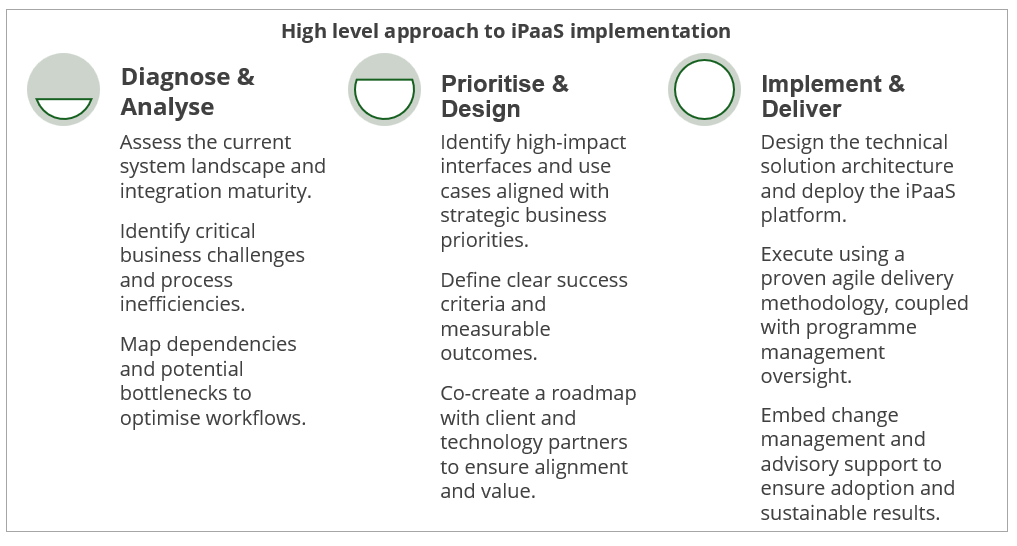
Effective iPaaS deployment programmes are contingent on multiple critical success factors: industry insight, advisory expertise, and strong collaboration with the client and technology providers. The focus should always be on solving the root causes of business challenges enabled by iPaaS to unlock measurable value.
Real impact comes from use cases that are co-created with stakeholders and aligned to clear outcomes, rather than deploying technology for its own sake. A disciplined programme management framework then ensures delivery stays on track, risks are managed, and benefits are realised. The diagram shows how best-practice iPaaS delivery links use case design, execution, and change management to achieve lasting business results.
6. Conclusion: Legacy systems are not a constraint with the right integration strategy
Bringing it all together, legacy systems are often seen as a constraint, but they remain a core asset within many businesses. With the right integration strategy, these systems can continue to generate significant value – not only by maintaining operational continuity but also by creating new opportunities for innovation. Instead of outright replacement, legacy environments can be re-imagined, allowing organisations to sweat these assets, extend their useful life, and maximise the return on years of investment.
This is where iPaaS becomes a true enabler. By providing seamless, scalable integration, it allows legacy systems to connect with modern applications and platforms, unlocking efficiencies and new business capabilities. The result is a more agile and responsive enterprise, able to leverage both existing infrastructure and emerging technologies to drive growth.
Letsema’s experience with iPaaS implementation
Letsema supports the journey towards unified systems end-to-end: from diagnosing system and process needs, to crafting a tailored integration strategy, through to execution and change management. We focus on making legacy work harder for you – transforming it from a cost centre into a source of business value and competitive advantage.
We have successfully applied this approach in a highly complex client environment, closing gaps across disparate systems and embedding optimised process logic aligned with the client’s strategic priorities. This delivered:
- Automation of manual processes: Eliminating repetitive tasks and freeing capacity to focus on higher-value strategic initiatives.
- Maximised system utilisation: Unlocking the full potential of existing platforms and elevating the role of IT as a critical enabler of business strategy.
- Professionalised service delivery: Aligning operations with global and standards observed in leading companies worldwide in similar industries.
- Scalable technology foundation: Establishing a robust, future-ready core that underpins the business and supports long-term growth strategy.
If your organisation is looking to unlock untapped value from its existing technology landscape while building for the future, Letsema is ready to partner with you. Please reach out to george.mukwawaya@letsema.co.za for further information.